
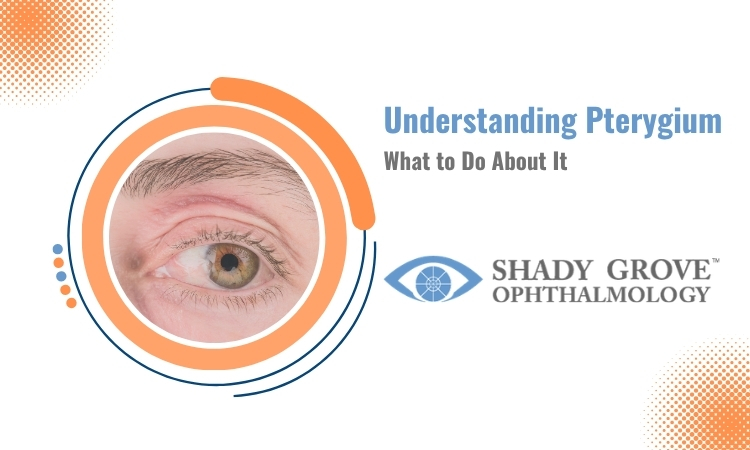
That Growth on Your Eye? Understanding Pterygium (Surfer’s Eye) and What to Do About It
By Shady Grove Ophthalmology | Rockville, Maryland
It usually starts small. Maybe you notice a slight redness in the corner of your eye that doesn’t go away. Or a faint, fleshy growth creeping in from the white part of your eye toward the colored center. It doesn’t hurt much, maybe just a little irritation, but it’s enough to make you wonder if something isn’t quite right.
If that sounds familiar, you might be dealing with a condition called pterygium.
At Shady Grove Ophthalmology in Rockville, MD, we see this more often than you might expect. The good news? In most cases, it’s manageable, and when treated appropriately, patients do very well.
Below, I’ll explain what pterygium is, why it happens, and what you should know if you think you might have it.
What Is a Pterygium?
A pterygium (pronounced tuh-RIJ-ee-um) is a non-cancerous growth of tissue that develops on the white part of the eye (the sclera) and can extend onto the cornea.
It’s often wedge-shaped and may appear:
-
Slightly raised
-
Pink, red, or flesh-colored
-
Growing from the inner corner of the eye toward the center
Because of its appearance, many patients describe it as a “film” or “growth” on the eye. You might also hear it referred to as “surfer’s eye”, which gives a clue about one of its main causes, environmental exposure.
How Common Is It?
Pterygium is more common than most people realize.
Globally, studies suggest that anywhere from 2% to 12% of the population may develop a pterygium, with higher rates in people who spend a lot of time outdoors.
In areas with significant sun exposure, like parts of the U.S., including Maryland, during peak seasons, we tend to see more cases.
At our Rockville office, we often diagnose pterygium in:
-
People who work outdoors
-
Drivers with long sun exposure
-
Golfers, runners, and outdoor enthusiasts
-
Patients with chronic dry or irritated eyes
It can affect one or both eyes and often develops gradually over time.
What Causes Pterygium?
The exact cause isn’t always a single factor, but we do know that UV exposure plays a major role.
Over time, exposure to sunlight, especially without eye protection, can trigger changes in the surface tissue of the eye.
Other contributing factors include:
-
Wind and dust exposure
-
Dry eye or chronic irritation
-
Environmental pollutants
-
Long-term outdoor activity
That’s why we often see pterygium in people who spend years outdoors without consistent eye protection.
Symptoms: What Does It Feel Like?
In its early stages, a pterygium may not cause noticeable symptoms.
But as it grows, patients may begin to experience:
-
Persistent redness
-
A feeling of irritation or dryness
-
Burning or itching
-
A gritty sensation (like something is in the eye)
-
Blurred vision (if it grows onto the cornea)
Some patients are more bothered by the appearance, while others notice discomfort first.
If the growth continues toward the center of the eye, it can begin to affect vision by altering the shape of the cornea, leading to astigmatism.
Is It Dangerous?
The word “growth” understandably makes people nervous.
The good news is that pterygium is not cancerous. However, that doesn’t mean it should be ignored.
If left untreated, it can:
-
Continue to grow
-
Cause chronic irritation
-
Affect vision
-
Become more difficult to treat over time
That’s why it’s important to have it evaluated, especially if you notice changes.
How Is Pterygium Treated?
Treatment depends largely on the size of the pterygium and how much it’s affecting your symptoms or vision.
Early or Mild Cases
In many cases, treatment is focused on managing symptoms.
This may include:
-
Reducing irritation
-
Improving comfort
-
Monitoring growth over time
Many patients live comfortably with small pterygia that don’t significantly affect vision.
When Does It Need Surgery?
Surgical removal may be recommended if the pterygium:
-
Continues to grow toward the center of the eye
-
Causes significant irritation
-
Affects vision
-
Becomes cosmetically concerning
Pterygium surgery involves removing the abnormal tissue and restoring a smooth surface to the eye.
Modern techniques are designed to:
-
Reduce recurrence
-
Improve healing
-
Maintain a natural appearance
At Shady Grove Ophthalmology, we carefully evaluate each patient to determine whether surgery is necessary or if monitoring is the better approach.
Does It Come Back After Treatment?
This is one of the most common questions patients ask.
Yes, pterygium can recur, but the likelihood depends on several factors, including:
-
Surgical technique
-
Environmental exposure after treatment
-
Individual healing response
With modern approaches and proper aftercare, recurrence rates are significantly lower than they used to be. Preventive habits, like UV protection, also play a big role in reducing recurrence.
Prevention: What You Can Do
This is where patients have more control than they might think. Since UV exposure is a major contributor, simple habits can go a long way. Wearing sunglasses with 100% UV protection is one of the most effective steps you can take.
Other helpful habits include:
-
Wearing a hat when outdoors
-
Avoiding excessive sun exposure during peak hours
-
Protecting your eyes in windy or dusty environments
-
Managing dry eye symptoms
These changes don’t just help prevent pterygium, they support overall eye health.
Why Patients Often Wait Too Long
Pterygium tends to develop slowly, which is why many people delay getting it checked. It doesn’t feel urgent. It’s not painful. It’s easy to ignore. But over time, that small growth can become more noticeable, and in some cases, more difficult to treat.
At our practice, we often see patients who say, “I’ve had this for years, but it never really bothered me until now.”
That’s usually the point where evaluation becomes important.
When Should You See an Eye Doctor?
If you notice any of the following, it’s worth scheduling an exam:
-
A visible growth on your eye
-
Persistent redness that doesn’t improve
-
Irritation or dryness that keeps coming back
-
Changes in vision
-
Increasing size of the growth
Even if it turns out to be something minor, it’s always better to know.
How We Help at Shady Grove Ophthalmology
At Shady Grove Ophthalmology in Rockville, MD, we take a thoughtful, personalized approach to conditions like pterygium. Every patient is different. Some need simple monitoring. Others may benefit from treatment or surgical intervention.
Our goal is to:
-
Provide a clear diagnosis
-
Explain your options in plain language
-
Help you make an informed decision
-
Protect your long-term vision
We also look at the bigger picture, because conditions like pterygium are often tied to environmental and lifestyle factors that we can help you manage.
A Simple Takeaway
If you’ve noticed something on your eye that doesn’t look or feel quite right, don’t ignore it. It may be something simple, but it may also be something that benefits from early attention. And when it comes to your eyes, early is always better.
Schedule an Eye Exam in Rockville, MD
If you’re experiencing symptoms or have noticed a growth on your eye, the team at Shady Grove Ophthalmology is here to help. We provide comprehensive eye exams and personalized care for patients throughout Rockville and Montgomery County.
📞 Schedule your appointment today (301) 279-0600
📆 Schedule a Comprehensive Eye Exam Online Here
Because when it comes to your vision, clarity starts with understanding what’s going on and knowing what to do next.